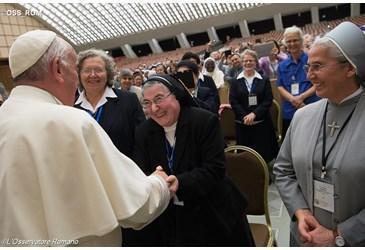
 Nella mattinata di ieri, giovedì 12 maggio, il Santo Padre Francesco ha incontrato nell’Aula Paolo VI le partecipanti all’Assemblea Plenaria delle Superiore Generali, in corso a Roma sul tema: “Tessere la solidarietà globale per la vita” e programmata a chiusura delle celebrazioni del Giubileo per i 50 anni dell’UISG.
L’incontro del Santo Padre con le Superiore Generali - oltre ottocento, provenienti da tutto il mondo - si è svolto in forma di dialogo. Di seguito riportiamo la trascrizione del colloquio:
Colloquio del Santo Padre
Prima domanda
Per un migliore inserimento delle donne nella vita della Chiesa
Papa Francesco, Lei ha detto che “il genio femminile è necessario in tutte le espressioni della vita della Chiesa e della società”, e tuttavia le donne sono escluse dai processi decisionali nella Chiesa, soprattutto ai più alti livelli, e dalla predicazione nell’Eucaristia. Un importante impedimento all’abbraccio pieno della Chiesa del “genio femminile” è il legame che sia i processi decisionali che la predicazione hanno con l’ordinazione sacerdotale. Lei vede un modo per separare dall’ordinazione sia i ruoli di leadership che la predicazione all’Eucaristia, in modo che la nostra Chiesa possa essere più aperta a ricevere il genio delle donne, in un futuro molto prossimo?
Papa Francesco
Sono varie cose qui che dobbiamo distinguere. La domanda è legata alla funzionalità, è legata molto alla funzionalità, mentre il ruolo della donna va oltre. Ma io adesso rispondo alla domanda, poi parliamo… Ho visto che ci sono altre domande che vanno oltre.
E’ vero che le donne sono escluse dai processi decisionali nella Chiesa: escluse no, ma è molto debole l’inserimento delle donne lì, nei processi decisionali. Dobbiamo andare avanti. Per esempio - davvero io non vedo difficoltà - credo che nel Pontificio Consiglio Giustizia e Pace che porta avanti la segreteria sia una donna, una religiosa. E’ stata proposta un’altra e io l’ho nominata, ma lei ha preferito di no, perché doveva andare da un’altra parte a fare altri lavori della sua Congregazione. Si deve andare oltre, perché per tanti aspetti dei processi decisionali non è necessaria l’ordinazione. Non è necessaria. Nella riforma della Cost. ap. Pastor Bonus, a proposito dei Dicasteri, quando non c’è la giurisdizione che viene dall’ordinazione – cioè la giurisdizionale pastorale – non si vede scritto che può essere una donna, non so se capo dicastero, ma… Per esempio per i migranti: al dicastero per i migranti una donna potrebbe andare. E quando c’è necessità – adesso che i migranti entrano in un dicastero – della giurisdizione, sarà il Prefetto a dare questo permesso. Ma nell’ordinario può andare, nell’esecuzione del processo decisionale. Per me è molto importante l’elaborazione delle decisioni: non soltanto l’esecuzione, ma anche l’elaborazione, e cioè che le donne, sia consacrate sia laiche, entrino nella riflessione del processo e nella discussione. Perché la donna guarda la vita con occhi propri e noi uomini non possiamo guardarla così. E’ il modo di vedere un problema, di vedere qualsiasi cosa, in una donna è diverso rispetto a quello che è per l’uomo. Devono essere complementari, e nelle consultazioni è importante che ci siano le donne.
Io ho avuto l’esperienza a Buenos Aires di un problema: vedendolo con il Consiglio presbiterale – quindi tutti uomini – era ben trattato; poi, il vederlo con un gruppo di donne religiose e laiche ha arricchito tanto, tanto, e favorito la decisione con una visione complementare. E’ necessario, è necessario questo! E penso che dobbiamo andare avanti, su questo poi il processo decisionale vedrà.
C’è poi il problema della predicazione nella Celebrazione Eucaristica. Non c’è alcun problema che una donna – una religiosa o una laica – faccia la predica in un Liturgia della Parola. Non c’è problema. Ma nella Celebrazione Eucaristica c’è un problema liturgico-dogmatico, perché la celebrazione è una - la Liturgia della Parola e la Liturgia Eucaristica, è un’unità – e Colui che la presiede è Gesù Cristo. Il sacerdote o il vescovo che presiede lo fa nella persona di Gesù Cisto. E’ una realtà teologico-liturgica. In quella situazione, non essendoci l’ordinazione delle donne, non possono presiedere. Ma si può studiare di più e spiegare di più questo che molto velocemente e un po’ semplicemente ho detto adesso.
Invece nella leadership non c’è problema: in quello dobbiamo andare avanti, con prudenza, ma cercando le soluzioni…
Ci sono due tentazioni qui, dalle quali dobbiamo guardarci.
La prima è il femminismo: il ruolo della donna nella Chiesa non è femminismo, è diritto! E’ un diritto di battezzata con i carismi e i doni che lo Spirito ha dato. Non bisogna cadere nel femminismo, perché questo ridurrebbe l’importanza di una donna. Io non vedo, in questo momento, un grande pericolo riguardo a questo tra le religiose. Non lo vedo. Forse una volta, ma non in genere non c’è.
L’altro pericolo, che è una tentazione molto forte e ne ho parlato parecchie volte, è il clericalismo. E questo è molto forte. Pensiamo che oggi più del 60 per cento delle parrocchie – delle diocesi non so, ma solo un po’ meno – non hanno il consiglio per gli affari economici e il consiglio pastorale. Questo cosa vuol dire? Che quella parrocchia e quella diocesi è guidata con uno spirito clericale, soltanto dal prete, che non attua quella sinodalità parrocchiale, quella sinodalità diocesana, che non è una novità di questo Papa. No! E’ nel Diritto Canonico, è un obbligo che ha il parroco di avere il consiglio dei laici, per e con laici, laiche e religiose per la pastorale e per gli affari economici. E questo non lo fanno. E questo è il pericolo del clericalismo oggi nella Chiesa. Dobbiamo andare avanti e togliere questo pericolo, perché il sacerdote è un servitore della comunità, il vescovo è un servitore della comunità, ma non è il capo di una ditta. No! Questo è importante. In America Latina, per esempio, il clericalismo è molto forte, molto marcato. I laici non sanno che cosa fare, se non domandano al prete… E’ molto forte. E per questo la consapevolezza del ruolo dei laici in America Latina è molto in ritardo. Si è salvato un po’ di questo solo nella pietà popolare: perché il protagonista è il popolo e il popolo ha fatto le cose come venivano; e ai preti quell’aspetto non interessava tanto, e qualcuno non vedeva di buon occhio questo fenomeno della pietà popolare. Ma il clericalismo è un atteggiamento negativo. Ed è complice, perché si fa in due, come il Tango che si balla in due… Cioè: il sacerdote che vuole clericalizzare il laico, la laica, il religioso e la religiosa, il laico che chiede per favore di essere clericalizzato, perché è più comodo. E’ curioso questo. Io, a Buenos Aires, ho avuto questa esperienza tre o quattro volte: un parroco bravo, che viene e mi dice “Sa, io ho un laico bravissimo in parrocchia: fa questo, fa questo, sa organizzare, si dà da fare, è davvero un uomo di valore…Lo facciamo diacono?”. Cioè: lo “clericalizziamo?”. “No! Lascia che rimanga laico. Non farlo diacono”. Questo è importante. A voi succede questo, che il clericalismo tante volte vi frena nello sviluppo lecito della cosa.
Io chiederò – e forse alla Presidente lo farò arrivare – alla Congregazione per il Culto che spieghi bene, in modo approfondito, quello che ho detto un po’leggermente sulla predicazione nella Celebrazione Eucaristica. Perché non ho la teologia e la chiarezza sufficiente per spiegarlo adesso. Ma bisogna distinguere bene: una cosa è la predicazione in una Liturgia della Parola, e questo si può fare; altra cosa è la Celebrazione eucaristica, qui c’è un altro mistero. E’ il Mistero di Cristo presente e il sacerdote o il vescovo che celebrano in persona Christi.
Per la leadership è chiaro… Sì credo che questa possa essere la mia risposta in generale alla prima domanda. Vediamo la seconda.
Seconda domanda
Il ruolo delle donne consacrate nella Chiesa
Le donne consacrate lavorano già tanto con i poveri e con gli emarginati, insegnano la catechesi, accompagnano i malati e i moribondi, distribuiscono la comunione, in molti Paesi guidano le preghiere comuni in assenza di sacerdoti e in quelle circostanze pronunciano l’omelia. Nella Chiesa c’è l’ufficio del diaconato permanente, ma è aperto solo agli uomini, sposati e non. Cosa impedisce alla Chiesa di includere le donne tra i diaconi permanenti, proprio come è successo nella Chiesa primitiva? Perché non costituire una commissione ufficiale che possa studiare la questione? Ci può fare qualche esempio di dove Lei vede la possibilità di un migliore inserimento delle donne e delle donne consacrate nella vita della Chiesa?
Papa Francesco
Questa domanda va nel senso del “fare”: le donne consacrate lavorano già tanto con i poveri, fanno tante cose… nel “fare”. E tocca il problema del diaconato permanente. Qualcuno potrà dire che le “diaconesse permanenti” nella vita della Chiesa sono le suocere [ride, ridono]. In effetti questo c’è nell’antichità: c’era un inizio... Io ricordo che era un tema che mi interessava abbastanza quando venivo a Roma per le riunioni, e alloggiavo alla Domus Paolo VI; lì c’era un teologo siriano, bravo, che ha fatto l’edizione critica e la traduzione degli Inni di Efrem il Siro. E un giorno gli ho domandato su questo, e lui mi ha spiegato che nei primi tempi della Chiesa c’erano alcune “diaconesse”. Ma che cosa sono queste diaconesse? Avevano l’ordinazione o no? Ne parla il Concilio di Calcedonia (451), ma è un po’ oscuro. Qual era il ruolo delle diaconesse in quei tempi? Sembra – mi diceva quell’uomo, che è morto, era un bravo professore, saggio, erudito – sembra che il ruolo delle diaconesse fosse per aiutare nel battesimo delle donne, l’immersione, le battezzavano loro, per il decoro, anche per fare le unzioni sul corpo delle donne, nel battesimo. E anche una cosa curiosa: quando c’era un giudizio matrimoniale perché il marito picchiava la moglie e questa andava dal vescovo a lamentarsi, le diaconesse erano le incaricate di vedere i lividi lasciati sul corpo della donna dalle percosse del marito e informare il vescovo. Questo, ricordo. Ci sono alcune pubblicazioni sul diaconato nella Chiesa, ma non è chiaro come fosse stato. Credo che chiederò alla Congregazione per la Dottrina della Fede che mi riferiscano circa gli studi su questo tema, perché io vi ho risposto soltanto in base a quello che avevo sentito da questo sacerdote che era un ricercatore erudito e valido, sul diaconato permanente. E inoltre vorrei costituire una commissione ufficiale che possa studiare la questione: credo che farà bene alla Chiesa chiarire questo punto; sono d’accordo, e parlerò per fare una cosa di questo genere.
Poi dite: “Siamo d’accordo con lei, Santo Padre, che ha più volte riportato la necessità di un ruolo più incisivo delle donne nelle posizioni decisionali nella Chiesa”. Questo è chiaro. “Ci può fare qualche esempio di dove Lei vede la possibilità di un migliore inserimento delle donne e delle donne consacrate nella vita della Chiesa?”. Dirò una cosa che viene dopo, perché ho visto che c’è una domanda generale. Nelle consultazioni della Congregazione per i religiosi, nelle assemblee, le consacrate devono andare: questo è sicuro. Nelle consultazioni sui tanti problemi che vengono presentati, le consacrate devono andare. Un’altra cosa: un migliore inserimento. Al momento non mi vengono in mente cose concrete, ma sempre quello che ho detto prima: cercare il giudizio della donna consacrata, perché la donna vede le cose con una originalità diversa da quella degli uomini, e questo arricchisce: sia nella consultazione, sia nella decisione, sia nella concretezza.
Questi lavori che voi fate con i poveri, gli emarginati, insegnare la catechesi, accompagnare i malati e i moribondi, sono lavori molti “materni”, dove la maternità della Chiesa si può esprimere di più. Ma ci sono uomini che fanno lo stesso, e bene: consacrati, ordini ospedalieri… E questo è importante.
Dunque, sul diaconato, sì, accetto e mi sembra utile una commissione che chiarisca bene questo, soprattutto riguardo ai primi tempi della Chiesa.
Riguardo a un migliore inserimento, ripeto quello che ho detto prima.
Se c’è qualcosa da concretizzare, domandatelo adesso: su questo che ho detto, c’è qualche domanda in più, che mi aiuti a pensare? Avanti…
Terza domanda
Il ruolo dell’Unione Internazionale delle Superiore Generali
Che ruolo potrebbe avere l’Unione Internazionale delle Superiore Generali, in modo che possa avere una parola nel pensiero della Chiesa, una parola che sia ascoltata, dal momento che porta con sé la voce di duemila istituti di religiose? Come è possibile che molto spesso veniamo dimenticate e non rese partecipi, per esempio dell’assemblea generale della Congregazione degli Istituti di Vita Consacrata e le Società di Vita Apostolica, lì dove si parla della vita consacrata? Può la Chiesa permettersi di continuare a parlare di noi, invece di parlare con noi?
Papa Francesco
Suor Teresina abbia un po’ di pazienza, perché mi è venuto in mente quello che era sfuggito dell’altra domanda, su “che cosa può fare la vita consacrata femminile?”. E’ un criterio che voi dovete rivedere, che anche la Chiesa deve rivedere. Il vostro lavoro, il mio e quello di tutti noi, è di servizio. Ma io, tante volte, trovo donne consacrate che fanno un lavoro di servitù e non di servizio. E’ un po’ difficile da spiegare, perché non vorrei che si pensasse a casi concreti, che forse sarebbe un cattivo pensiero, perché nessuno conosce bene le circostanze. Ma pensiamo a un parroco, un parroco che per sicurezza immaginiamo: “No, no, la mia canonica è in mano a due suore” – “E sono loro che gestiscono?” – “Sì, sì!” – “E cosa fanno di apostolato, catechesi?” – “No, no, soltanto quello!”. No! Questo è servitù! Mi dica, signor parroco, se nella sua città non ci sono donne brave, che hanno bisogno di lavoro. Ne prenda una, due, che facciano quel servizio. Queste due suore, che vadano nelle scuole, nei quartieri, con gli ammalati, con i poveri. Questo è il criterio: lavoro di servizio e non di servitù! E quando, a voi Superiore, chiedono una cosa che è più di servitù che di servizio, siate coraggiose nel dire “no”. Questo è un criterio che aiuta parecchio, perché quando si vuole che una consacrata faccia un lavoro di servitù, si svaluta la vita e la dignità di quella donna. La sua vocazione è il servizio: servizio alla Chiesa, ovunque sia. Ma non servitù!
Ecco, adesso [rispondo a] Teresina: “Qual è, secondo lei, il posto della vita religiosa apostolica femminile all’interno della Chiesa? Che cosa mancherebbe alla Chiesa se non ci fossero più le religiose?”. Mancherebbe Maria il giorno di Pentecoste! Non c’è Chiesa senza Maria! Non c’è Pentecoste senza Maria! Ma Maria era lì, non parlava forse… Questo l’ho detto, ma mi piace ripeterlo. La donna consacrata è una icona della Chiesa, è un’icona di Maria. Il prete, il sacerdote, non è icona della Chiesa; non è icona di Maria: è icona degli apostoli, dei discepoli che sono inviati a predicare. Ma non della Chiesa e di Maria. Quando dico questo voglio farvi riflettere sul fatto che “la” Chiesa è femminile; la Chiesa è donna: non è “il” Chiesa, è “la” Chiesa. Ma è una donna sposata con Gesù Cristo, ha il suo Sposo, che è Gesù Cristo. E quando un vescovo è scelto per una diocesi, il vescovo – in nome di Cristo – sposa quella Chiesa particolare. La Chiesa è donna! E la consacrazione di una donna la fa icona proprio della Chiesa e icona della Madonna. E questo noi uomini non possiamo farlo. Questo vi aiuterà ad approfondire, da questa radice teologica, un ruolo grande nella Chiesa. E questo vorrei che non sfuggisse.
Mi trovo totalmente d’accordo [sulla conclusione della terza domanda]. La Chiesa: la Chiesa siete voi, siamo tutti. La gerarchia – diciamo – della Chiesa deve parlare di voi, ma prima e nel momento deve parlare con voi! Questo è sicuro. Nell’Assemblea della CIVCSVA voi dovete essere presenti. Sì, sì! Io questo lo dirò al Prefetto: nell’Assemblea voi dovete essere presenti! E’ chiaro, perché parlare di un assente non è neanche evangelico: deve poter sentire, ascoltare che cosa si pensa, e poi facciamo insieme. Sono d’accordo. Io non immaginavo tanto distacco, davvero. E grazie di averlo dirlo così coraggiosamente e con quel sorriso.
Mi permetto una battuta. Lei lo ha fatto con quel sorriso, che in Piemonte si dice il sorriso della mugna quacia [con una faccia ingenua]. Brava! Sì, voi avete ragione in questo. Credo che sia facile riformare, io ne parlerò con il Prefetto. “Ma questa Assemblea generale non parlerà delle suore, parlerà di un’altra cosa…” – “E’ necessario sentire le suore perché hanno un’altra visione della cosa”. E’ quello che avevo detto prima: è importante che siate sempre inserite... Vi ringrazio della domanda.
Qualche chiarimento riguardo a questo? Qualcosa di più? E’ chiaro?
Ricordate bene questo: cosa mancherebbe alla Chiesa se le religiose non esistessero? Mancherebbe Maria nel giorno di Pentecoste. La religiosa è icona della Chiesa e di Maria; e la Chiesa è femminile, sposata da Gesù Cristo.
Quarta domanda
Gli ostacoli che incontriamo come donne consacrate all’interno della Chiesa.
Carissimo Santo Padre, molti istituti stanno affrontando la sfida di portare novità nella forma di vita e nelle strutture rivedendo le Costituzioni. Questo si sta rivelando difficile, perché ci ritroviamo bloccate dal Diritto Canonico. Lei prevede cambiamenti nel Diritto Canonico, in modo da facilitare questa novità?
Inoltre i giovani oggi hanno difficoltà a pensare ad un impegno permanente, sia nel matrimonio che nella vita religiosa. Potremmo essere aperte a impegni temporanei?
E un altro aspetto: svolgendo il nostro ministero in solidarietà con i poveri e gli emarginati, veniamo spesso erroneamente considerate come attiviste sociali o come se prendessimo posizioni politiche. Alcune autorità ecclesiali vorrebbero che fossimo più mistiche e meno apostoliche. Quale valore viene dato alla vita consacrata apostolica e in particolare alle donne, da alcune parti della Chiesa gerarchica?
Papa Francesco
Primo: i cambiamenti che si devono fare per assumere le nuove sfide: Lei ha parlato di novità, novità nel senso positivo, se ho capito bene, cose nuove che vengono… E la Chiesa è maestra in questo, perché ha dovuto cambiare tanto, tanto, tanto nella storia. Ma in ogni cambiamento ci vuole il discernimento, e non si può fare discernimento senza preghiera. Come si fa il discernimento? La preghiera, il dialogo, poi il discernimento in comune. Bisogna chiedere il dono del discernimento, di saper discernere. Per esempio, un imprenditore deve fare cambiamenti nella sua ditta: lui valuta con concretezza, e quello che la sua coscienza gli dice, lo fa. Nella nostra vita, c’entra un altro personaggio: lo Spirito Santo. E per fare un cambiamento, dobbiamo valutare tutte le circostanze concrete, questo è vero, ma per entrare in un processo di discernimento con lo Spirito Santo ci vogliono preghiera, dialogo e discernimento comune. Credo che su questo punto noi non siamo ben formati – quando dico “noi” parlo anche dei sacerdoti – nel discernimento delle situazioni, e dobbiamo cercare di avere esperienze e anche cercare qualche persona che ci spieghi bene come si fa il discernimento: un buon padre spirituale che conosca bene queste cose e ci spieghi, che non è un semplice “pro e contro”, fare la somma, e avanti. No, è qualcosa di più. Ogni cambiamento che si deve fare, richiede di entrare in questo processo di discernimento. E questo vi darà più libertà, più libertà! Il Diritto Canonico: ma non c’è nessun problema. Il Diritto Canonico nel secolo scorso è stato cambiato – se non sbaglio – due volte: nel 1917 e poi sotto san Giovanni Paolo II. Piccoli cambiamenti si possono fare, si fanno. Questi invece sono stati due cambiamenti di tutto il Codice. Il Codice è un aiuto disciplinare, un aiuto per la salvezza delle anime, per tutto questo: è l’aiuto giuridico della Chiesa per i processi, tante cose, ma che nel secolo scorso due volte, è stato totalmente cambiato, rifatto. E così si possono cambiare delle parti. Due mesi fa è arrivata una richiesta di cambiare un canone, non ricordo bene… Ho fatto fare lo studio e il Segretario di Stato ha fatto le consultazioni e tutti erano d’accordo che sì, questo si doveva cambiare per il maggior bene, ed è cambiato. Il Codice è uno strumento, questo è molto importante. Ma insisto: mai fare un cambiamento senza fare un processo di discernimento, personale e comunitario. E questo vi darà libertà, perché mettete lì, nel cambiamento, lo Spirito Santo. E’ questo che ha fatto san Paolo, san Pietro stesso, quando ha sentito che il Signore lo spingeva a battezzare i pagani. Quando noi leggiamo il libro degli Atti degli Apostoli, ci meravigliamo di tanto cambiamento, tanto cambiamento… E’ lo Spirito! Interessante, questo: nel libro degli Atti degli Apostoli, i protagonisti non sono gli apostoli, è lo Spirito. “Lo Spirito costrinse a fare quello”; “lo Spirito disse a Filippo: vai là e là, trova il ministro dell’economia e battezzalo”; “Lo Spirito fa”, “lo Spirito dice: no, qui non venite”… E’ lo Spirito. E’ lo Spirito che ha dato il coraggio agli apostoli per fare questo cambiamento rivoluzionario di battezzare i pagani senza fare la strada della catechesi ebraica o delle prassi ebraiche. E’ interessante: nei primi capitoli c’è la Lettera che gli apostoli, dopo il Concilio di Gerusalemme, inviano ai pagani convertiti. Raccontano tutto quello che hanno fatto: “Lo Spirito Santo e noi abbiamo deciso questo”. Questo è un esempio di discernimento che hanno fatto. Ogni cambiamento, fatelo così, con lo Spirito Santo. Cioè: discernimento, preghiera e anche valutazione concreta delle situazioni.
E per il Codice non c’è problema, questo è uno strumento.
Riguardo all’impegno permanente dei giovani. Noi viviamo in una “cultura del provvisorio”. Mi raccontava un vescovo, tempo fa che era andato da lui un giovane universitario, che aveva finito l’università, 23/24 anni, e gli aveva detto: “Io vorrei diventare sacerdote, ma solo per dieci anni”. E’ la cultura del provvisorio. Nei casi matrimoniali è cosi. “Io ti sposo finché dura l’amore e poi ciao”. Ma l’amore inteso in senso edonistico, nel senso di questa cultura di oggi. Ovviamente questi matrimoni sono nulli, non sono validi. Non hanno coscienza della perpetuità di un impegno. Nei matrimoni è così. Nell’Esortazione apostolica Amoris laetitia leggete la problematica, è nei primi capitoli, e leggete come preparare il matrimonio. Mi diceva una persona: “Io questo non lo capisco: per diventare prete dovete studiare, prepararvi per otto anni, più o meno. E poi, se la cosa non va, o se ti innamori di una bella ragazza, la Chiesa ti permette: vai, sposati, incomincia un’altra vita. Per sposarsi – che è per tutta la vita, che è “per” la vita – la preparazione in tante diocesi sono tre, quattro conferenze… Ma questo non va! Come può un parroco firmare che questi sono preparati al matrimonio, con questa cultura del provvisorio, con quattro spiegazioni soltanto? E’ un problema molto serio. Nella vita consacrata, a me sempre ha colpito – positivamente – l’intuizione di san Vincenzo de Paoli: lui ha visto che le Suore della Carità dovevano fare un lavoro così forte, così “pericoloso”, proprio in frontiera, che ogni anno devono rinnovare i voti. Soltanto per un anno. Ma lo aveva fatto come carisma, non come cultura del provvisorio: per dare libertà. Io credo che nella vita consacrata i voti temporanei facilitino questo. E, non so, voi vedete, ma io sarei piuttosto favorevole forse di prolungare un po’ i voti temporanei, per questa cultura del provvisorio che hanno i giovani oggi: è… prolungare il fidanzamento prima di fare il matrimonio! Questo è importante.
[Ora il Papa risponde a una parte della domanda che non è stata letta ma era scritta]
Le richieste di soldi nelle nostre Chiese locali. Il problema dei soldi è un problema molto importante, sia nella vita consacrata, sia nella Chiesa diocesana. Non dobbiamo mai dimenticare che il diavolo entra “per le tasche”: sia per le tasche del vescovo, sia per le tasche della Congregazione. Questo tocca il problema della povertà, ne parlerò dopo. Ma l’avidità di denaro è il primo scalino per la corruzione di una parrocchia, di una diocesi, di una Congregazione di vita consacrata, è il primo scalino. Credo che fosse a questo proposito: il pagamento per i sacramenti. Guardate, se qualcuno vi chiede questo, denunciate il fatto. La salvezza è gratuita. Dio ci ha inviato gratuitamente; la salvezza è come uno “spreco di gratuità”. Non c’è salvezza a pagamento, non ci sono sacramenti a pagamento. E’ chiaro questo? Io conosco, ho visto nella mia vita corruzione in questo. Ricordo un caso, appena nominato vescovo, avevo la zona più povera di Buenos Aires: è divisa in quattro vicariati. Lì c’erano tanti migranti dei Paesi americani, e succedeva che quando venivano a sposarsi i parroci dicevano: “Questa gente non ha il certificato di battesimo”. E quando lo richiedevano nel loro paese dicevano loro: “Sì, ma manda prima 100 dollari – ricordo un caso – e poi te lo invio”. Ho parlato con il cardinale, il cardinale ha parlato con il vescovo del posto… Ma nel frattempo la gente poteva sposarsi senza il certificato di battesimo, con il giuramento dei genitori o dei padrini. E questo è il pagamento, non solo del sacramento ma dei certificati. Ricordo una volta a Buenos Aires che è andato un giovane, che doveva sposarsi, alla parrocchia per chiedere il nulla osta per sposarsi in un’altra: è un mezzo semplice. Gli ha detto la segretaria: “Sì, passi domani, venga domani che ci sarà, e questo costa tanto”: una bella somma. Ma è un servizio: è soltanto constatare i dati e riempire. E lui – questo è un avvocato, giovane, bravo, molto fervente, molto buon cattolico – è venuto da me: “Adesso cosa faccio?” – “Vai domani e dille che hai inviato l’assegno all’arcivescovo, e che l’arcivescovo le darà l’assegno”. Il commercio dei soldi.
Ma qui tocchiamo un problema serio, che è il problema della povertà. Io vi dico una cosa: quando un istituto religioso – e questo vale anche per altre situazioni –, ma quando un istituto religioso si sente morire, sente che non ha capacità di attirare nuovi elementi, sente che forse è passato il tempo per il quale il Signore aveva scelto quella Congregazione, la tentazione è l’avidità. Perché? Perché pensano: “Almeno abbiamo i soldi per la nostra vecchiaia”. Questo è grave. E qual è la soluzione che dà la Chiesa? L’unione di vari istituti con carismi che si assomigliano, e andare avanti. Ma mai, mai il denaro è una soluzione per i problemi spirituali. E’ un aiuto necessario, ma tanto quanto. Sant’Ignazio diceva, sulla povertà, che è “madre” e “muro” della vita religiosa. Ci fa crescere nella vita religiosa come madre, e la custodisce. E si incomincia la decadenza quando manca la povertà. Ricordo, nell’altra diocesi, quando un collegio di suore molto importante doveva rifare la casa delle suore perché era vecchia, si doveva rifare; e hanno fatto un bel lavoro. Hanno fatto un bel lavoro. Ma in quei tempi – sto parlando dell’anno ’93, ’94 più o meno – dicevano: “Facciamo tutte le comodità, la stanza con il bagno privato, e tutto, e anche il televisore…”. In quel collegio, che era tanto importante, dalle 2 alle 4 del pomeriggio tu non trovavi una suora in collegio: erano tutte in stanza a guardare la telenovela! Perché è mancanza di povertà, e questo ti porta alla vita comoda, alle fantasie… E’ un esempio, forse è l’unico nel mondo, ma per capire il pericolo della troppa comodità, della mancanza di povertà o di una certa austerità.
[Altra parte della domanda non letta ma scritta]
“Le religiose non ricevono uno stipendio per i servizi che svolgono, come lo ricevono i preti. Come possiamo dimostrare un volto attraente della nostra sussistenza? Come possiamo trovare le risorse finanziare necessarie per compiere la nostra missione?”.
Papa Francesco
Vi dirò due cose. Prima: vedere come è il carisma, l’interno del vostro carisma – ognuno ha il proprio – e qual è il posto della povertà, perché ci sono congregazioni che esigono una vita di povertà molto, molto forte; altre, non tanto, e tutte e due approvate dalla Chiesa. Cercare la povertà secondo il carisma. Poi: i risparmi. E’ prudenza avere un risparmio; è prudenza avere una buona amministrazione, forse con qualche investimento, quello è prudente: per le case di formazione, per portare avanti le opere povere, portare avanti scuole per i poveri, portare avanti i lavori apostolici… Una fondazione della propria congregazione: questo lo si deve fare. E come la ricchezza può far male e corrompere la vocazione, la miseria pure. Se la povertà diventa miseria, anche questo fa male. Lì si vede la prudenza spirituale della comunità nel discernimento comune: l’economa informa, tutti parlano, sì è troppo, non è troppo… Quella prudenza materna. Ma per favore, non lasciatevi ingannare dagli amici della congregazione, che poi vi “spenneranno” e vi toglieranno tutto. Ho visto tante case, o mi hanno raccontato altri, di suore che hanno perduto tutto perché si sono fidati di quel tale… “molto amico della congregazione”! Ci sono tanti furbi, tanti furbi. La prudenza è non consultare mai una sola persona: quando avete bisogno, consultare varie persone, diverse. L’amministrazione dei beni è una responsabilità molto grande, molto grande, nella vita consacrata. Se non avete il necessario per vivere, ditelo al vescovo. Dire a Dio: “Dacci oggi il nostro pane”, quello vero. Ma parlare col vescovo, con la Superiora generale, con la Congregazione per i religiosi. Per il necessario, perché la vita religiosa è un cammino di povertà, ma non è un suicidio! E questa è la sana prudenza. E’ chiaro questo?
E poi, dove ci sono conflitti per quello che le Chiese locali vi chiedono, bisogna pregare, discernere e avere il coraggio, quando si deve, di dire “no”; e avere la generosità, quando si deve, di dire “sì”. Ma voi vedete quanto è necessario il discernimento in ogni caso!
Domanda (ripresa)
“Mentre svolgiamo il nostro ministero, rimaniamo solidali con i poveri e gli emarginati, veniamo spesso erroneamente considerate come attiviste sociali o come se prendessimo posizioni politiche. Alcune autorità ecclesiali guardano negativamente al nostro ministero, sottolineando che dovremmo essere più concentrate su una forma di vita mistica. In queste circostanze, come possiamo vivere la nostra vocazione profetica…”.
Risposta (continua)
Sì. Tutte le religiose, tutte le consacrate devono vivere misticamente, perché il vostro è uno sposalizio; la vostra è una vocazione di maternità, è una vocazione di essere al posto della Madre Chiesa e della Madre Maria. Ma quelli che vi dicono questo, pensano che essere mistico è essere una mummia, sempre così pregando… No, no. Si deve pregare e lavorare secondo il proprio carisma; e quando il carisma ti porta ad andare avanti con i rifugiati, con i poveri tu devi farlo, e ti diranno “comunista”: è il meno che ti diranno. Ma devi farlo. Perché il carisma ti porta a questo. In Argentina, ricordo una suora: è stata provinciale della sua congregazione. Una brava donna, e lavora ancora… ha quasi la mia età, sì. E lavora contro i trafficanti di giovani, di persone. Io ricordo, nel governo militare in Argentina, volevano mandarla in carcere, facevano pressione sull’arcivescovo, facevano pressione sulla superiora provinciale, prima che lei stessa diventasse provinciale, “perché questa donna è comunista”. E questa donna ha salvato tante ragazze, tante ragazze! E sì, è la croce. Di Gesù che cosa hanno detto? Che era Belzebù, che aveva il potere di Belzebù. La calunnia, siate preparate. Se fate il bene, con preghiera, davanti a Dio, assumendo tutte le conseguenze del vostro carisma e andate avanti, preparatevi per la diffamazione e la calunnia, perché il Signore ha scelto questa via per Sé! E noi, vescovi, dobbiamo custodire queste donne che sono icona della Chiesa, quando fanno cose difficili e sono calunniate, e sono perseguitate. Essere perseguitati è l’ultima delle Beatitudini. Il Signore ci ha detto: “Beati voi quando sarete perseguitati, insultati” e tutte queste cose. Ma qui il pericolo può essere: “Io faccio la mia” – no, no: tu senti questo, ti perseguitano: parla. Con la tua comunità, con la tua superiora, parla con tutti, cerca consiglio, discerni: un’altra volta la parola. E questa religiosa della quale parlavo ora, un giorno l’ho trovata che piangeva, e diceva: “Guarda la lettera che ho ricevuto da Roma – non dirò da dove –: cosa devo fare?” – “Tu sei figlia della Chiesa?” – “Sì!” – “Tu vuoi obbedire alla Chiesa?” – “Sì!” – “Rispondi che tu sarai obbediente alla Chiesa, e poi va’ dalla tua superiora, va’ dalla tua comunità, va’ dal tuo vescovo – che ero io – e la Chiesa dirà cosa devi fare. Ma non una lettera che viene da 12.000 km”. Perché lì un amico dei nemici della suora aveva scritto, era stata calunniata. Coraggiose, ma con umiltà, discernimento, preghiera, dialogo.
Conclusione
“Una parola di incoraggiamento a noi leader, che sopportiamo il peso della giornata”.
Papa Francesco
Ma datevi anche un respiro! Il riposo, perché tante malattie vengono dalla mancanza di un sano riposo, riposo in famiglia… Questo è importante per sopportare il peso della giornata.
Voi menzionate qui anche le suore anziane e ammalate. Ma queste suore sono la memoria dell’istituto, queste suore sono quelle che hanno seminato, che hanno lavorato, e adesso sono paralitiche o molto malate o lasciate da parte. Queste suore pregano per l’Istituto. Questo è molto importante, che si sentano coinvolte nella preghiera per l’Istituto. Queste suore hanno anche un’esperienza tanto grande: chi più, chi meno. Ascoltarle! Andare da loro: “Mi dica, sorella, cosa pensa lei di questo, di questo?”. Che si sentano consultate e dalla loro saggezza uscirà un buon consiglio. State sicure.
Questo è quello che mi viene di dirvi. So che io sempre mi ripeto e dico le stesse cose, ma la vita è così… A me piace sentire le domande, perché mi fanno pensare e mi sento come il portiere, che sta lì, aspettando il pallone dove viene… Questo è buono e questo fate anche voi nel dialogo.
Queste cose che ho promesso di fare, le farò. E pregate per me, io prego per voi. E andiamo avanti. La nostra vita è per il Signore, per la Chiesa e per la gente, che soffre tanto e ha bisogno della carezza del Padre, tramite voi! Grazie!
Vi propongo una cosa: finiamo con la Madre. Ognuna di voi, nella propria lingua, preghi l’Ave Maria. Io la pregherà in spagnolo.
Ave Maria…
[Benedizione]
E pregate per me, perché possa servire bene la Chiesa.
Traduzione di lavoro in lingua inglese a cura della Sala Stampa
MEETING WITH THE INTERNATIONAL UNION OF SUPERIORS GENERAL
12 May 2016
First question
For a better integration of women in the life of the Church
Pope Francis, you have said that “the feminine genius is necessary in all expressions of the life of the Church and of society”, and yet women are excluded from decision-making processes in the Church, especially at the highest levels, and from preaching in the Eucharist. An important obstacle to Church’s full embrace of the “feminine genius” is the bond that both decision-making processes and preaching have with priestly ordination. Do you see a way of separating from ordination both leadership roles and preaching in the Eucharist, so that our Church can be more open to receiving the genius of women in the very near future?
Pope Francis
We must distinguish between various things here. The question is linked to functionality, it is closely linked to functionality, while the role of women goes beyond this. But I will answer the question now, then we will speak … I have seen that there are other questions that go beyond this.
It is true that women are excluded from decision-making processes in the Church: excluded no, but the integration of women is very weak there, in decision-making processes. We must move forward. For example – truly I see no difficulties – I believe that in the Pontifical Council for Justice and Peace the secretariat is managed by a woman religious. Another was proposed and I appointed her but she preferred not to accept as she would have had to go elsewhere and do other work in her Congregation. We must move forward, because in many aspects of decision-making processes ordination is not necessary. It is not necessary. In the reform of the Apostolic Constitution Pastor Bonus, on the dicasteries, when there is no competence deriving from ordination – that is, pastoral competence – I have not seen it in writing that it can be a woman, I don’t know about a head of a dicastery, but … For example, for migrants: at the dicastery for migrants there could be a woman. And when it is necessary – now that migrants enter into a dicastery, into its competence, it will be for the Prefect to give this permission. But ordinarily, in the execution of decision-making processes, it can be done. For me the influence on decisions is very important: not only the execution, but also the development, and therefore that women, both consecrated and laywomen, enter into reflection on the process, and in discussion. Because women look at life through their own eyes and we men cannot look at it in this way. The way of viewing a problem, of seeing things, is different in a woman compared to a man. They must be complementary, and in consultations it is important that there are women.
I experienced a problem in Buenos Aires: viewing it with the priests’ council – therefore all men – it was treated well, but then seeing it with a group of religious and lay women it was greatly enriched, and this helped the decision by offering a complementary vision. This is necessary! And I think that we must move forward on this, then in the decision-making process we will see.
Then there is the problem of preaching at the Eucharistic Celebration. There is no problem for a woman – religious or lay – to preach in the Liturgy of the Word. There is no problem. But at the Eucharistic Celebration there is a liturgical-dogmatic problem, because it is one celebration – the Liturgy of the Word and the Eucharistic Liturgy, there is unity between them – and He Who presides is Jesus Christ. The priest or bishop who presides does so in the person of Jesus Christ. It is a theological-liturgical reality. In that situation, since women are not ordained, they cannot preside. But it is possible to study and explain further what I have very quickly and rather simply said just now.
In leadership, instead, there is no problem: in that respect we must go forward, with prudence, but seeking solutions. …
There are two temptations here, against which we must be on guard.
The first is feminism: the role of the woman in the Church is not feminism, it is a right! It is a right through baptism, with the charisms and the gifts that the Spirit has given. We must not fall into the trap of feminism, because this would reduce the importance of a woman. I do not see, at this moment, a great danger of this among women religious. I do not see it. Perhaps previously, but in general it is not present.
The other danger, a very b temptation I have spoken about several times, is clericalism. And this is very b. Let us consider that today more than 60 per cent of parishes – of dioceses I don’t know, but marginally fewer – do not have a council for economic affairs or a pastoral council. What does this mean? It means that the parish or diocese is led with a clerical spirit, by the priest alone, and that it does not implement the synodality in the parish, in the diocese, which is not a novelty under this Pope. No! It is a matter of canon law: the parish priest is obliged to have a council of, for and with laymen, laywomen and women religious for pastoral ministry and for economic affairs. And they do not do this. This is the danger of clericalism in the Church today. We must go ahead and remove this danger, because the priest is a servant of the community, the bishop is a servant of the community, but he is not the head of a firm. No! This is important. In Latin America, for example, clericalism is very b and pronounced. Laypeople do not know what to do, if they do not ask the priest. It is very b. And for this reason an awareness of the role of the laity has been very delayed. It is saved in part only through popular piety, as the protagonist of this is the people, and the people have done things as they come to them, and priests in this regard have not been very interested; some have not seen this phenomenon of popular piety in a positive light. But clericalism is a negative attitude. And it takes complicity: it is something that is done by two parties, just as it takes two to dance the tango. … That is: the priest seeks to clericalise the layman, the laywoman, the man or woman religious, and the layperson asks to be clericalised, because it is easier that way. And this is curious. In Buenos Aires, I had this experience three or four times: a good priest came to me and said, “I have a very good layperson in my parish: he does this and that, he knows how to organise things, he gets things done. … Shall we make him a deacon?” Or rather: shall we “clericalise” him? “No! Let him remain a layperson. Don’t make him a deacon”. This is important. It often happens to you that clericalism obstructs the correct development of something.
I will ask – and perhaps the President will communicate this – for the Congregation for Divine Worship to explain well and in depth what I said rather briefly on preaching in the Eucharistic Celebration, as I do not have sufficient theology or clarity to explain it now. But it is necessary to differentiate clearly: one thing is the preaching in a Liturgy of the Word, and this can be done, but another thing is the Eucharistic Celebration; here there is another mystery. It is the mystery of Christ’s presence and the priest or the bishop who celebrate in persona Christi.
For leadership it is clear. … Yes, I think that in this there can be my general answer to the first question. We will see for the second.
Second question
The role of consecrated women in the Church
Consecrated women already do much work with the poor and the marginalised, they teach catechism, they accompany the sick and dying, they distribute the communion, in many countries they lead common prayers in the absence of priests and in those circumstances they pronounce the homily. In the Church there is the office of the permanent diaconate, but it is open only to men, married or not. What prevents the Church from including women among permanent deacons, as was the case in the primitive Church? Why not constitute an official commission to study the matter? Can you give an example of where you see the possibility of better integration of women and consecrated women in the life of the Church?
Pope Francis
This question goes in the direction of “doing”: consecrated women already do much work with the poor, they do many things … “doing”. And it touches on the problem of the permanent diaconate. Some might say that the “permanent deaconesses” in the life of the Church are mothers-in-law [laughter]. In effect this exists in antiquity: there was a beginning. …I remember that it was a theme I was quite interested in when I came to Rome for meetings, and I stayed at the Domus Paolo VI; there was a good Syrian theologian there, who had produced a critical edition and translation of the Hymns of Ephrem the Syrian. One day I asked him about this, and he explained to me that in the early times of the Church there were some “deaconesses”. But what were these deaconesses? Were they ordained or not? The Council of Chalcedon (451) speaks about this but it is somewhat obscure. What was the role of deaconesses in those times? It seems – I was told by this man, who is now dead but who was a good professor, wise and erudite – it seems that the role of the deaconesses was to help in the baptism of women, their immersion; they baptised them for the sake of decorum, and also to anoint the body of women, in baptism. And another curious thing: when there was a judgement on a marriage because a husband hit his wife and she went to the bishop to complain, deaconesses were responsible for inspecting the bruises left on the woman’s body from her husband’s blows, and for informing the bishop. This, I remember. There are various publications on the diaconate in the Church, but it is not clear how it was. I think I will ask the Congregation for the Doctrine of the Faith to refer me to some studies on this theme, because I have answered you only on the basis of what I heard from this priest, who was an erudite and able researcher, on the permanent diaconate. In addition, I would like to constitute an official commission to study the question: I think it will be good for the Church to clarify this point, I agree, and I will speak so as to do something of this type.
Then you say: “We agree with you, Holy Father, that you have on several occasions raised the issue of the need for a more incisive role for women in decision-making roles in the Church”. This is clear. “Can you give me an example of where you see the possibility of better integration of women and consecrated women in the life of the Church?”. I will say something that comes after, because I have seen that there is a general question. In the consultations of the Congregation for men and women religious, in the assemblies, women religious must be present: this is certain. Another thing: better integration. At the moment concrete examples do not come to mind, but there is always what I said earlier: seeking the judgement of the consecrated women, because women see things with an originality that is different to that of men, and this enriches, both in consultation and decision-making, and in practice.
These works that you carry out with the poor, the marginalised, teaching catechesis, accompanying the sick and the dying, are very “maternal” tasks, where the maternity of the Church is expressed the most. But there are men who do the same, and well: consecrated men, hospital orders … and this is important.
So, with regard to the diaconate, yes, I agree and it seems to me it would be useful to have a commission to clarify this well, especially with regard to the early times of the Church.
With regard to better integration, I repeat what I said earlier.
If there is something to be made clear, please ask me now: are there any further questions on what I have said, that may help me to think? Go ahead.
Third Question
The role of the International Union of Superiors General
What role could the International Union of Superiors General play, in order to have a word in the thinking of the Church, a word that is listened to, from the moment that it carries with it the voice of 2,000 institutes of women religious? How is it possible that quite often we are forgotten and not included as participants, for example in the General Assembly of the Congregation for the Institutes of Consecrated Life and Societies of Apostolic Life [CICLAVA], where consecrated life is discussed? Can the Church afford to continue speaking about us, instead of speaking with us?
Pope Francis
Sr Teresina have a little patience because it just came to mind what had escaped regarding the other question, on “the role of consecrated women in the Church” It is a point that you must review, which the Church must also review. Your work, my work and that of all of us, is that of service. Very often I find women consecrated who perform a labour of servitude and not of service. It is somewhat difficult to explain, because I would not to suggest a concrete case, which might be a bad thought, because no one really knows the circumstances. Let us consider a parish priest, a priest who to be sure we might imagine: “No, no, my rectory is in the hands of two nuns” — “Are they the ones who run it?” — “Yes, yes!” — “What do they do as far as pastoral care, catechesis?” — “No, no, only that!”. No! This is servitude! Tell me, Mr Parish Priest, are there no good women in the city, who need work? Take on one or two who could perform that service. Let these two sisters go to the schools, the neighbourhoods, with the sick, with the poor. This is the criterion: a labour of service and not of servitude! When you Superiors are asked something that is more servitude than service, have the courage to say ‘no’. This is a rather helpful point, because when a consecrated woman is asked to perform work of servitude, it demeans the life and dignity of that woman. But no servitude!
Now then, [I’ll respond to] Teresina: “What, in your opinion, is the place of woman’s apostolic religious life within the Church? What would the Church be lacking if there were no longer women religious?”. [It would be as if] Mary were missing on the day of Pentecost! There is no Church without Mary! There is not Pentecost without Mary! But Mary was there, she may not have spoken.... I have said this, but I like to repeat it. The consecrated woman is an icon of the Church, an icon of Mary. The priest is not an icon of the Church; he is not the icon of Mary; he is an icon of the Apostles, of the disciples who were sent to preach. But not of the Church or of Mary. When I say this I want to make you reflect on the fact that “she” the Church is feminine; the Church is woman: it is not “he” the Church, it is “she” the Church. But she is a woman married to Jesus Christ, she has her Bridegroom, who id Jesus Christ. When a bishop is chosen for a diocese, the bishop — on behalf of Christ — marries that particular Church. The Church is woman! And a woman’s consecration makes her the very icon of the Church and icon of Our Lady. We men cannot do this. This will help you to deepen, from this theological root, a great role in the Church. I hope this does not elude you.
I completely agree [with the conclusion of the third question]. The Church: you are the Church, we all are. The hierarchy — as we say — of the Church must speak of you, but first and in the moment it must speak with you. This is certain. You must be present in the ciclava. Yes, yes! I shall tell this to the Prefect: you must be present in the Assembly! It is clear, because to speak about one who is absent is not even evangelical: one must be able to hear, to listen to what is thought, and then let us do so together. I agree. I did not imagine such separation, truly. Thank you for have said it so courageously and with that smile.
Allow me to joke. You did so with a smile, which in Piedmont is described as the smile of the miller’s facade [with a sincere expression]. Well done! Yes, you are right about this, I shall speak about it with the Prefect. “But this General Assembly will not speak about nuns, it will speak about something else...” — “It is important to hear the nuns because they have another way of looking at things”. That is what I was saying before: it is important that you always be included.... I thank you for the question.
Shall I clarify this further? Is something further needed? Is it clear?
Remember this well: what would the Church be lacking if women religious did not exist? Mary would be missing on the day of Pentecost. Women religious are the icon of the Church and of Mary.
The Church is woman, married to Jesus Christ.
Fourth Question
The obstacles we encounter within the Church as consecrated women
Beloved Holy Father, many institutes are facing the challenge of revising their Constitutions in order to innovate their way of life and their structures. This is proving to be difficult due to obstacles in canon law. Do you foresee any changes to canon law in order facilitate this process?
Moreover, young people today have difficulty thinking about a life commitment, be it matrimony or religious life. Can we be open somehow to trial commitments?
And another aspect: In carrying out our ministry of solidarity with the poor and marginalised, we are often mistaken for being social or political activists. Some ecclesial authorities would prefer that become more mystical and less apostolic. What value ought certain sectors Church hierarchy give to the consecrated life as apostolic and women in particular?
Pope Francis:
Firstly, the changes that need to happen to take on new challenges: You spoke about innovation, innovation in the positive sense if I understood correctly, new things on the way. In this the Church is an expert, for she has had to change so very much throughout history. Yet in every change discernment is needed, and discernment cannot be accomplished without prayer. How does one undertake discernment? Prayer, dialogue, then shared discernment. One must ask for the gift of discernment, to know how to discern. For example, an entrepreneur has to make changes in his business: he makes concrete assessments and that which his conscience tells him to do, he does. In our lives another character plays a role: the Holy Spirit. In order to make a change we must evaluate all concrete circumstances, this is all true, but in order to advance in discernment with the Holy Spirit what is needed is prayer, dialogue and shared discernment. I believe that on this point we––and by this I mean priests as well––are not well formed in the discernment of situations and we must try to experience those things and those people who can explain well what discernment means: a good spiritual father who knows these things well and explains them to us, that is not a simple “for and against” or summation and so forth. No, it is something more than this. And this will give you greater freedom, greater freedom! Regarding canon law: there is no issue here. Canon law in the last century was changed––if I am not mistaken––twice: in 1917 and then under John Paul II. Small changes that can be done, are done. But these two changes were instead of the entire Code. The Code is a disciplinary help, a help for the salvation of souls, for everything: it is the juridical help of the Church for all processes, so many things, but last century twice it was totally changed, remade. And just so, parts of it can be changed. Two months past a request arrived asking for a canon to be changed, I don’t remember exactly [the details]. I studied it and the Secretary of State made the proper consultations and everyone was in agreement that yes, this must be changed for the greater good, and it was changed. The Code is an instrument, this is very important. But I insist: never make a change without a process of discernment, both personal and communal. And this will give you freedom, for you place the Holy Spirit there in the change. St. Paul did the same, as did St. Peter, when he felt the Lord urging him baptize the pagans. When we read the book of the Acts of the Apostles we wonder at such a change, such a change…it is the Holy Spirit! This is very interesting: in the book of the Acts of the Apostles the protagonists are not just the Apostles, but also the Spirit. “The Spirit moved him to do that”; “the Spirit said to Phillip to go here and there, find the minister of economic affairs and baptize him”; “the Spirit does”, “the Spirit says no, do not come here”––it is the Spirit. It is the Spirit who has given the Apostles courage to make this revolutionary change to baptize the pagans without taking the approach of Jewish catechism or Jewish praxis. It is also interesting: in the first chapters there is the Letter that the Apostles sent to the pagan converts after the Council of Jerusalem. It tells of all that has been accomplished: “The Holy Spirit and we have decided this.” This is an example of discernment, prayer and even the concrete evaluation of situations. And for the Code this is not an issue, for it is an instrument.
Regarding young people and life commitments. We live in a “culture of the provisional”. A bishop told me, some time ago a young university student came to him – he had just finished university, 23/24 years, and he said to him: “I would like to become a priest, but only for 10 years”. That is the culture of the provisional. In marriage it is the same thing. “ I will be married to you as long as love lasts and then it's 'goodbye'”. But that is love taken in the hedonistic sense, in the sense of today's culture. Obviously, these marriages mean nothing; they are not valid. They have no awareness of the permanence of a commitment. Marriage is not like that. In the Apostolic Exhortation Amoris Laetitia you read about the problem in the first chapters and you read about marriage preparation. A person said to me: “I don't understand this: to become priests you have to study, prepare for eight years, more or less. And yet, if it doesn't go well, or if you fall in love with a beautiful girl, the Church gives you a pass: go, get married, begin a new life. To get married – which is for life, which is “for” life – preparation in many dioceses are three or four meetings.... But this isn't enough! How can a parish priest attest that these two are prepared for marriage, in this culture of the provisional, with just four conversations? This is a very serious problem. In consecrated life, was has always struck me – in a positive way – is the intuition of St Vincent de Paul: he saw that the Sisters of Charity had a job that was so demanding, so “dangerous”, on the front lines, that every year they should renew their vows. Just for one year. But he did this as a charism, not in the culture of the provisional: in order to give freedom. I believe that in consecrated life temporary vows facilitate this. And, I don't know, you will see, but I would rather prolong temporary vows a little, because of this culture of the provisional that has young people in its grasp these days: it is like, prolonging the engagement before marriage! This is important.
[Now the Pope answers a part of the question that was written but not read]
Requests for money in our local Churches. The problem of money is a very important problem, both in consecrated life and in the diocesan Church. We must never forget that the devil enters through our pockets: the pockets of the bishop and the pockets of the Congregation. This touches on the problem of poverty, which we will speak about later. But greed for money is the first step towards corruption in a parish, in a diocese, in a Congregation of consecrated life: it is the first step. I think that in this respect there has been payment for sacraments. Look, if someone asks you for this, then report the incident. Salvation is free. God sent us freely. There is no salvation by payment, there are no sacraments by payment. Is this clear? I know, I have seen corruption in this during my life. I remember one case, when I had just been appointed as bishop. I had the poorest area of Buenos Aires, divided into four vicariates. There were many migrants from American countries there, and often when they came to get married the priests would say, “These people have no certificate of baptism”. And when they requested them from their countries they were told: “Yes, but first send a hundred dollars – I remember a case – and then I will send it to you”.
I spoke with the cardinal, and the cardinal spoke with the bishop of the place. … But in the meantime people were able to marry without their certificate of baptism, with guarantees from their parents or godparents. And this is payment, not only for the sacrament but also for certificates. I remember once in Buenos Aires that a young man came to ask for a nulla osta to marry in another parish, a simple matter. The secretary told him: “Yes, if you come by tomorrow it will be here, and it will cost a certain price”, a large sum. But it is a service: it is a question of ascertaining and compiling data. And he – he was a lawyer, young, good and a very devout and good Catholic – he came to me and said, “Now what shall I do?”. “Come tomorrow and say that you have sent the cheque to the archbishop, and that the archbishop will give her the cheque”. The trade in money.
But here we touch upon a serious problem, which is the problem of poverty. I will say something to you: when a religious institute – and this is also valid for other situations – but when a religious institute feels that it is dying, it feels that it no longer has the capacity to attract new elements, it feels that perhaps the time has passed for which the Lord had chosen that Congregation, there is the temptation of greed. Why? Because they think, “At least we have money for our old age”. This is serious. And what is the solution that the Church can give? To unite the various institutes with similar charisms, and to go ahead. But money is never, ever a solution for spiritual problems. It is a necessary aid, but just that. St. Ignatius used to say about poverty that it is the “mother” and “wall” of religious life. It enables us to grow in religious life like a mother, and protects. And when poverty is missing, then decadence takes hold. I remember, in the other diocese, when a very important college of nuns had to renovate their house because it was old, and they did a good job. But in those times – I am talking about the years 1993, 1994 more or less – they said, “Let’s have all the comforts, the room with a private bathroom, and everything, and a television too…”. In that college, which was so important, from 2 to 4 in the afternoon you could never find a nun: they were all in their rooms watching a soap opera! Because there was a lack of poverty, and this leads to the comfortable life, to fantasies. … It is an example, maybe the only one in the world, but helps us understand the danger of too much comfort, of the lack of poverty or a certain austerity.
[Other part of the question, not read but written]
“Women religious do not receive a stipend for their services, as priests do. How can we show an attractive face of our subsistence? How can we find the financial resources necessary to fulfil our mission?”
Pope Francis
I will say to things to you. First: see how your charism is, the content of your charism –everyone has their own – and what the role of poverty is, because there are congregations that call for a very, very strict life of poverty, and others less so, and both types are approved by the Church. Live poverty according to the charism. Then: savings. It is prudent to have savings; it is prudent to have good administration, perhaps with some investment, that is prudent; for the houses of formation, to run works for the poor, to manage schools for the poor, for apostolic works. … A foundation for one’s own congregation: this is what should be done. And just as wealth can do harm to and corrupt a vocation, so can destitution. If poverty becomes destitution, this too causes harm. There you see the spiritual prudence of the community in common discernment: the bursar informs, everyone speaks about whether it is too much or not. That is motherly prudence. But please, do not let yourselves be fooled by friends of the congregation, who then fleece you and take everything from you. I have seen so many cases, or others have told me about cases in which nuns have lost everything because they trusted someone or other, a “great friend of the congregation”! There are many cunning people, so many. Prudence means never consulting only one person: when you need something, consult various different people. The administration of assets is a very serious responsibility, very serious, in consecrated life. If you do not have the means to live, tell the bishop. Tell God, “Give us this day our daily bread”, the true one. But speak with the bishop, with the Superior general, with the Congregation for Religious. For the necessary means, because religious life is a path of poverty, but it is not suicide! And this is healthy prudence. Is that clear?
And then, where there are conflicts for what the local Churches ask of you, you need to pray, to discern and to have the courage, when necessary, to say “no”; and to have the generosity, when you need to, to say “yes”. But you see how discernment is necessary in every case!
Question (resumed)
“While we carry out our ministry, we are in solidarity with the poor and the marginalised, and are often mistakenly considered as social activists, as if we were assuming political stances. Some Church authorities look on our ministry negatively, underlining that we should concentrate more on a kind of mystical life. In these circumstances, how can we live our prophetic vocation?”
Answer (resumed)
Yes. All religious women, all consecrated women should live mystically, because yours is a marriage: your is a vocation of maternity, it’s a vocation of being in the role of Mother Church and of Mother Mary. But those who tell you this, they think that being a mystic is being a mummy, always praying like that… No, no. You have to pray and to work according to your own charism, and when the charism brings you to work with refugees, to work with the poor, you should do it, and they will call you “communist,” that’s the least they will say about you. But you should do it. Because the charism brings you to this. In Argentina, I remember a nun, she was provincial of her congregation. A good woman, and she’s still working… she’s about half my age. And she works against those who traffic youngsters, who traffic people. I remember, with the military government in Argentina, they wanted to put her in jail, putting pressure on the archbishop, putting pressure on the provincial superior, before she became provincial, “because this woman is a communist.” And this woman saved so many girls, so many girls! And yes, it’s the cross. What did they say about Jesus? That he was Beelzebub, that he had the power of Beelzebub. Calumny, be prepared for it. If you do good, with prayer, before God, taking on all the consequences of your charism and you go ahead, prepare yourselves for defamation and calumny, because the Lord has chosen this way for himself! And we bishops, ought to watch over these women who are an icon of the Church, when they do difficult things, and are slandered and persecuted. To be persecuted is the last of the Beatitudes. The Lord said: “Blessed are you when you are persecuted, insulted” and all these things. But here the danger can be: “I do my thing” – no, no: hear this: they persecute you – speak. With your community, with your superior, speak with everyone, ask for advice, discern: once again this word. And this nun of whom I was speaking now, one day I found her crying, and she said, “Look at the letter that I received from Rome – I don’t know from where – what should I do?” – “Are you a daughter of the Church?” – “Yes!” – “Do you want to obey the Church?” – “Yes!” – “Answer that you will be obedient to the Church, then go to your superior, go to your community, go to your bishop – that was me – and the Church will tell you what to do. But not a letter that comes from 12,000 kilometres away.” Because there a friend of the enemies of the nun had written, and she was slandered. Be courageous, but with humility, discernment, prayer, dialogue.
Conclusion
“A word of encouragement for us leaders, who carry the weight of the day”.
Pope Francis
But take a breather! Rest, because so many sicknesses come from a lack of healthy rest, rest in the family… This is important to carry the weight of the day.
You also talk here about old and sick nuns. But these nuns are the memory of the institute, these nuns are those who have sowed, who have worked, and now are paralysed, or very sick, or left off to the side. These nuns pray for the institute. This is very important, that they feel involved in the prayer for the Institute. These nuns also have a very extensive experience: some more, some less. Listen to them! Go to them: “Tell me, sister, what do you think about this, about this?” That they feel consulted, and from their wisdom will come good advice. Be sure of it.
This is what I would like to tell you. I know that I always repeat myself and say the same things, but life is like that. … I like hearing questions, because they make me think and I feel like a goalkeeper who stands there, waiting for the ball from wherever it comes. … This is good, and you also do this in dialogue.
The things I have promised to do, I will do. And pray for me, I will pray for you. Let us go ahead. Our life is for the Lord, for the Church and for the people, who suffer greatly and need the caress of the Father, through you! Thank you.
I would like to suggest something: let us finish with the Mother. Each one of you, in your own language, pray the Hail Mary. I will pray in Spanish.
Hail Mary…
[Blessing]
And pray for me, so that I might serve the Church well.
© http://press.vatican.va/content/salastampa/it/bollettino.html - 13 maggio 2016