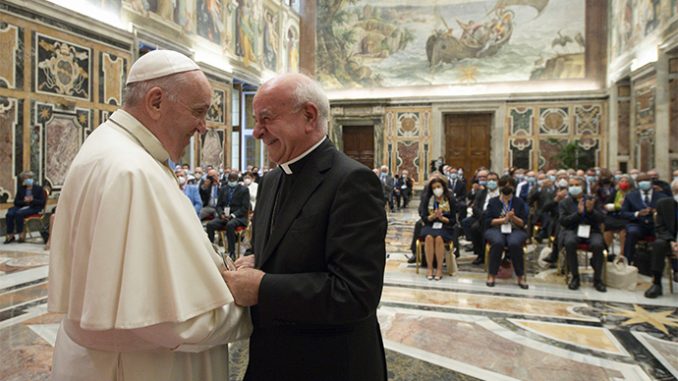
 In an interview granted to Settimana News on May 21, 2026, Bishop Vincenzo Paglia claimed a decisive role in the dissolution of the John Paul II Institute for Studies on Marriage and Family and its replacement by a new academic entity, as well as in the radical transformation of the Pontifical Academy for Life. He also made clear that these interventions were intended to bring about a profound paradigm shift, which—for the first time—he explicitly acknowledged as affecting not only the pastoral sphere but the doctrinal one as well.
According to Paglia, this “very profound” reform entailed, above all, a rethinking of the very concept of natural law. Paglia accused the John Paul II Institute of advancing a conception of natural law understood as a set of immutable principles from which moral norms are deduced. He proposed, instead, that natural law must be grounded in an ongoing historical discernment of subjective and cultural experience. In this perspective, a “theology within history and within people’s lives” must replace what he characterized as the late Institute’s “armchair theology.”
We must ask ourselves whether Paglia’s criticism corresponds to the work carried out by the John Paul II Institute. Only then will we be in a position to evaluate the merits of Paglia’s new doctrinal proposals and understand the true reason for the abolition of the institute.
Read more on CWR