 © Sala Stampa Santa Sede - 1 giugno 2019
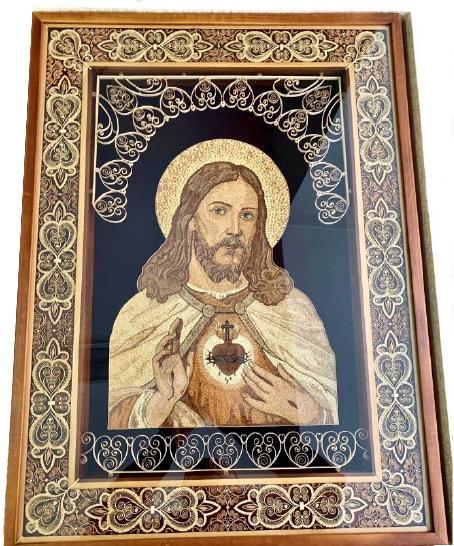
Sacro Cuore in legno. Dono offerto alla Casa Arcidiocesana di Jakab Antal Haz (Sumuleu-Ciuc). Interamente realizzato in filigrana di carta multicolore, questa rappresentazione del Sacro Cuore di Gesù imita un celebre olio ottocentesco di scuola portoghese.
La tecnica della filigrana, consistente nell’arrotolare strisce di carta, modellate ed incollate insieme per creare disegni decorativi, è molto antica. Già durante il Rinascimento, infatti, veniva utilizzata soprattutto in ambito monastico, per decorare non solo le copertine dei libri e altri articoli religiosi, ma soprattutto nel confezionamento delle teche che contenevano le reliquie dei santi.
Questa riproduzione del Sacro Cuore di Gesù non solo è un esempio di come la tradizionale lavorazione in filigrana di carta si sia trasmessa fino ad oggi, ma soprattutto è la testimonianza di una speciale devozione i cui primi impulsi risalgono, addirittura, a certe mistiche tardo medievali di area tedesca, come suor Matilde di Magdeburgo (1207-1282).
Lo sviluppo e la fioritura della devozione al Sacro Cuore di Gesù avviene però grazie alle apparizioni ricevute dalla suora visitandina Margherita Maria Alacoque e da alcuni confratelli gesuiti. Quest’ultimi, in particolare, nel 1760 diedero un ulteriore impulso attraverso la committenza a Pompeo Batoni della celeberrima rappresentazione del Sacro Cuore, divenuta certamente la più riprodotta delle raffigurazioni della corporeità umana di Gesù. Una corporeità che ha una sua speciale adorazione, non solo in quanto indissolubilmente unita con la Divinità, ma soprattutto perché rappresenta quell’amore speciale per l’umanità, di cui il cuore di Gesù è simbolo.
È per tale ragione, infatti, che esso è rappresentato incoronato di spine, sovrastato dalla croce e ferito dalla lancia in eterna memoria del più alto gesto d’amore: il sacrificio sulla Croce per la salvezza dell’uomo; nonché circondato dalle fiamme, in riferimento all’ardore misericordioso che Cristo prova per i peccatori.
Come è infatti scritto nel Vangelo di Matteo: “Venite a me, voi tutti che siete affaticati e oppressi, e io vi ristorerò. Prendete il mio giogo sopra di voi e imparate da me, che sono mite e umile di cuore e troverete ristoro per le vostre anime” (11, 28-29).
ROMANIA – Șumuleu Ciuc - Archdiocesan House of Jakab Antal Haz
GIFT
Sacred Heart in wood. Gift offered to the Archdiocesan House of Jakab Antal Haz (Șumuleu Ciuc). Entirely produced in coloured paper filigree, this representation of the Sacred Heart of Jesus imitates a famous nineteenth-century oil painting of the Portuguese school. The filigree technique, consisting of rolling strips of paper, modelled and glued together to create decorative designs, is very ancient. Indeed, already during the Renaissance it was used especially in the monastic environment, to decorate not only the covers of books and other religious articles, but especially in the production of the cases containing relics of the saints.
This reproduction of the Sacred Heart of Jesus is not only an example of how traditional paper filigree work has been handed down to this day, but also and above all is evidence of a special devotion whose first impulses date back from as far as certain late Medieval mystics from the German area, such as Sister Mechthild of Magdeburg (1207-1282).
The development and flourishing of devotion to the Sacred Heart of Jesus occurred, however, thanks to the apparitions received by the Visitandine nun Margherita Maria Alacoque, and some Jesuit confreres. These latter, in particular, gave a further boost in 1760 through the commission to Pompeo Batoni of the renowned representation of the Sacred Heart, which had certainly become the most reproduced of the depictions of Jesus’ human corporality – a corporality which has its special worship, not only inasmuch as it is inseparably united with Divinity, but above all since it represents that special love for humanity, of which the heart of Jesus is the symbol.
It is for this reason, in fact, that it is represented as crowned with thorns, surmounted by the cross and wounded by the lance in eternal memory of the highest gesture of love: the sacrifice on the Cross for the salvation of man; it is also surrounded by flames, with reference to the merciful ardour that Christ feels for sinners.
As is indeed written in the Gospel of Matthew: “Come to me, all you who are weary and burdened, and I will give you rest. Take my yoke upon you and learn from me, for I am gentle and humble in heart, and you will find rest for your souls” (11: 28-29).