
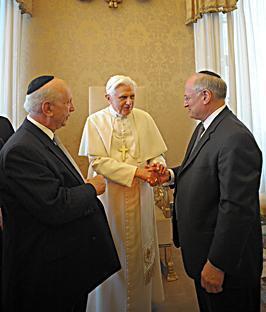
 Qualsiasi negazione o minimizzazione del terribile crimine della Shoah è "intollerabile e del tutto inaccettabile". Lo ha ribadito il Papa incontrando giovedì mattina, 12 febbraio, i membri della Conferenza dei Presidenti delle Maggiori Organizzazioni Ebraiche Americane.
 Cari amici,
sono lieto di accogliere tutti voi oggi e ringrazio il rabbino Arthur Schneier e il signor Alan Solow per i saluti che mi hanno rivolto a vostro nome. Ricordo bene le varie occasioni, durante la mia visita negli Stati Uniti lo scorso anno, nelle quali ho potuto incontrare alcuni di voi a Washington e a New York. Lei, rabbino Schneier, con cortesia mi ha ricevuto presso la Park East Synagogue alcune ore prima della vostra celebrazione della Pasqua. Ora, sono lieto di avere l'occasione di offrirle ospitalità qui nella mia casa. Incontri come questo ci permettono di dimostrare il nostro rispetto reciproco. Voglio che sappiate che voi siete tutti davvero benvenuti qui oggi nella casa di Pietro, la casa del Papa. Ricordo con gratitudine le varie occasioni che ho avuto nel corso di molti anni di trascorrere del tempo in compagnia dei miei amici ebrei. Le mie visite, seppure brevi, alle vostre comunità a Washington e a New York, sono state esperienza di stima fraterna e amicizia sincera. Così è accaduto anche durante la visita alla sinagoga a Colonia, la prima di questo tipo del mio pontificato. È stato per me molto commovente trascorrere alcuni momenti con la comunità ebraica nella città che conosco così bene, la città che ha ospitato il più antico insediamento ebraico in Germania e le cui origini risalgono al tempo dell'impero romano.
Un anno dopo, nel maggio del 2006, ho visitato il campo di sterminio di Auschwitz-Birkenau. Quali parole possono esprimere in modo adeguato quell'esperienza profondamente toccante? Entrando in quel luogo di orrore, scenario di indicibile sofferenza, ho meditato sugli innumerevoli prigionieri, così tanti di loro ebrei, che avevano percorso quello stesso cammino nella prigionia ad Auschwitz e in tutti gli altri campi di prigionia. Quei figli di Abramo, colpiti dal lutto e spaventosamente umiliati, avevano ben poco per sostenersi oltre alla propria fede nel Dio dei loro padri, una fede che noi cristiani condividiamo con voi, nostri fratelli e nostre sorelle. Come possiamo cominciare a comprendere l'enormità di ciò che è accaduto in quelle prigioni infami? L'intero genere umano prova una profonda vergogna per la brutalità selvaggia mostrata allora verso il vostro popolo. Permettetemi di ripetere quanto ho detto in quella triste occasione: "I potentati del Terzo Reich volevano schiacciare il popolo ebraico nella sua totalità; eliminarlo dall'elenco dei popoli della terra. Allora le parole del Salmo: "Siamo messi a morte, stimati come pecore al macello" si verificarono in modo terribile".
Il nostro incontro odierno si svolge nel contesto della vostra visita in Italia in concomitanza con la vostra annuale Leadership Mission in Israele. Anche io mi sto preparando a visitare Israele, una terra che è santa per i cristiani e per gli ebrei, poiché le radici della nostra fede si trovano lì. Infatti, la Chiesa trae sostentamento dalla radice di quel buon albero di olivo, il popolo di Israele, su cui sono stati innestati i rami di olivo selvatico dei Gentili (cfr. Romani, 11, 17-24). Fin dai primi giorni del cristianesimo, la nostra identità e ogni aspetto della nostra vita e del nostro culto sono intimamente legati all'antica religione dei nostri padri nella fede.
La storia bimillenaria del rapporto fra l'ebraismo e la Chiesa ha attraversato molte diverse fasi, alcune delle quali dolorose da ricordare. Ora che possiamo incontrarci in spirito di riconciliazione, non dobbiamo permettere alle difficoltà passate di trattenerci dal porgerci reciprocamente la mano dell'amicizia. Infatti, quale famiglia non è mai stata attraversata da tensioni di un tipo o dell'altro? La Dichiarazione del concilio Vaticano ii Nostra aetate è stata una pietra miliare lungo il cammino verso la riconciliazione e ha chiaramente evidenziato i principi che hanno governato da allora l'atteggiamento della Chiesa nelle relazioni fra cristiani ed ebrei. La Chiesa è profondamente e irrevocabilmente impegnata a rifiutare ogni forma di antisemitismo e a continuare a costruire relazioni buone e durature fra le nostre due comunità. Una particolare immagine che esprime questo impegno è quella del momento in cui il mio amato predecessore Papa Giovanni Paolo II ha sostato presso il Muro occidentale di Gerusalemme, implorando il perdono di Dio dopo tutta l'ingiustizia che il popolo ebraico aveva dovuto subire. Ora faccio mia la sua preghiera: "Dio dei nostri padri, tu hai scelto Abramo e la sua discendenza perché il tuo Nome fosse portato alle genti: noi siamo profondamente addolorati per il comportamento di quanti nel corso della storia hanno fatto soffrire questi suoi figli, e chiedendoti perdono vogliamo impegnarci in un'autentica fraternità con il popolo dell'alleanza. Per Cristo nostro Signore" (26 marzo 2000).
L'odio e il disprezzo per uomini, donne e bambini manifestati nella Shoah sono stati un crimine contro Dio e contro l'umanità. Questo dovrebbe essere chiaro a tutti, in particolare a quanti appartengono alla tradizione delle Sacre Scritture, secondo le quali ogni essere umano è creato a immagine e somiglianza di Dio (Genesi, 1, 26-27). È ovvio che qualsiasi negazione o minimizzazione di questo terribile crimine è intollerabile e del tutto inaccettabile. Di recente, in un'udienza pubblica, ho riaffermato che la Shoah deve essere un "monito contro l'oblio, contro la negazione o il riduzionismo, perché la violenza fatta contro un solo essere umano è violenza contro tutti" (8 gennaio 2009).
Questo capitolo terribile della nostra storia non dovrà mai essere dimenticato.
Il ricordo, come si dice giustamente, è memoria futuri, un ammonimento a noi per il futuro e un monito a lottare per la riconciliazione. Ricordare significa fare tutto il possibile per prevenire qualsiasi recrudescenza di questa catastrofe nella famiglia umana, edificando ponti di amicizia duratura. Prego con fervore affinché il ricordo di questo crimine orrendo rafforzi la nostra determinazione a guarire le ferite che da troppo tempo affliggono le relazioni fra cristiani ed ebrei. Desidero sinceramente che la nostra amicizia divenga sempre più forte affinché l'impegno irrevocabile della Chiesa per relazioni rispettose e armoniose con il popolo dell'Alleanza portino frutti abbondanti.
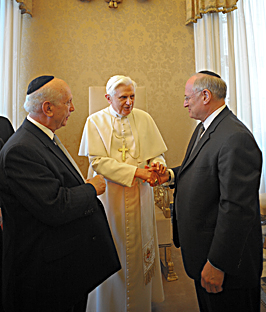 Dear Friends,
I am pleased to welcome all of you today, and I thank Rabbi Arthur Schneier and Mr Alan Solow for the greetings they have addressed to me on your behalf. I well recall the various occasions, during my visit to the United States last year, when I was able to meet some of you in Washington D.C. and New York. Rabbi Schneier, you graciously received me at Park East Synagogue just hours before your celebration of Pesah. Now, I am glad to have this opportunity to offer you hospitality here in my own home. Such meetings as this enable us to demonstrate our respect for one another. I want you to know that you are all most welcome here today in the house of Peter, the home of the Pope.
I look back with gratitude to the various opportunities I have had over many years to spend time in the company of my Jewish friends. My visits to your communities in Washington and New York, though brief, were experiences of fraternal esteem and sincere friendship. So too was my visit to the Synagogue in Cologne, the first such visit in my Pontificate. It was very moving for me to spend those moments with the Jewish community in the city I know so well, the city which was home to the earliest Jewish settlement in Germany, its roots reaching back to the time of the Roman Empire.
A year later, in May 2006, I visited the extermination camp at Auschwitz-Birkenau. What words can adequately convey that profoundly moving experience? As I walked through the entrance to that place of horror, the scene of such untold suffering, I meditated on the countless number of prisoners, so many of them Jews, who had trodden that same path into captivity at Auschwitz and in all the other prison camps. Those children of Abraham, grief-stricken and degraded, had little to sustain them beyond their faith in the God of their fathers, a faith that we Christians share with you, our brothers and sisters. How can we begin to grasp the enormity of what took place in those infamous prisons? The entire human race feels deep shame at the savage brutality shown to your people at that time. Allow me to recall what I said on that sombre occasion: "The rulers of the Third Reich wanted to crush the entire Jewish people, to cancel it from the register of the peoples of the earth. Thus the words of the Psalm, "We are being killed, accounted as sheep for the slaughter', were fulfilled in a terrifying way".
Our meeting today occurs in the context of your visit to Italy in conjunction with your annual Leadership Mission to Israel. I too am preparing to visit Israel, a land which is holy for Christians as well as Jews, since the roots of our faith are to be found there. Indeed, the Church draws its sustenance from the root of that good olive tree, the people of Israel, onto which have been grafted the wild olive branches of the Gentiles (cf. Rom 11: 17-24). From the earliest days of Christianity, our identity and every aspect of our life and worship have been intimately bound up with the ancient religion of our fathers in faith.
The two-thousand-year history of the relationship between Judaism and the Church has passed through many different phases, some of them painful to recall. Now that we are able to meet in a spirit of reconciliation, we must not allow past difficulties to hold us back from extending to one another the hand of friendship. Indeed, what family is there that has not been troubled by tensions of one kind or another? The Second Vatican Council's Declaration Nostra Aetate marked a milestone in the journey towards reconciliation, and clearly outlined the principles that have governed the Church's approach to Christian-Jewish relations ever since. The Church is profoundly and irrevocably committed to reject all anti-Semitism and to continue to build good and lasting relations between our two communities. If there is one particular image which encapsulates this commitment, it is the moment when my beloved predecessor Pope John Paul ii stood at the Western Wall in Jerusalem, pleading for God's forgiveness after all the injustice that the Jewish people have had to suffer. I now make his prayer my own: "God of our fathers, you chose Abraham and his descendants to bring your Name to the Nations: we are deeply saddened by the behaviour of those who in the course of history have caused these children of yours to suffer, and asking your forgiveness we wish to commit ourselves to genuine brotherhood with the people of the Covenant" (26 March 2000).
The hatred and contempt for men, women and children that was manifested in the Shoah was a crime against God and against humanity. This should be clear to everyone, especially to those standing in the tradition of the Holy Scriptures, according to which every human being is created in the image and likeness of God (Gen 1: 26-27). It is beyond question that any denial or minimization of this terrible crime is intolerable and altogether unacceptable. Recently, in a public audience, I reaffirmed that the Shoah must be "a warning for all against forgetfulness, denial or reductionism, because violence committed against one single human being is violence against all" (28 January 2009).
This terrible chapter in our history must never be forgotten. Remembrance - it is rightly said - is memoria futuri, a warning to us for the future, and a summons to strive for reconciliation. To remember is to do everything in our power to prevent any recurrence of such a catastrophe within the human family by building bridges of lasting friendship. It is my fervent prayer that the memory of this appalling crime will strengthen our determination to heal the wounds that for too long have sullied relations between Christians and Jews. It is my heartfelt desire that the friendship we now enjoy will grow ever ber, so that the Church's irrevocable commitment to respectful and harmonious relations with the people of the Covenant will bear fruit in abundance.
(©L'Osservatore Romano - 13 febbraio 2009)